

Choosing Among Four Engineering Ceramics
A chip substrate needs to carry heat away. A thermal spacer needs to limit heat flow. Start with the role of the part, then consider electrical insulation, wear and the features that must be machined.
Material comparison
| Material | Thermal conductivity¹ | Typical uses and strengths | Design considerations |
|---|---|---|---|
| Alumina · Al₂O₃ | 25–35 | Standard grades are relatively economical. Wear resistance and electrical insulation suit supports and guides. | Protect thin edges, hole rims and corners against chipping during clamping. |
| Aluminum nitride · AlN | 140–220 | Combines thermal conductivity with electrical insulation for power-module substrates. | Thin sections and narrow webs between holes need even support during machining and assembly. |
| Silicon carbide · SiC | 80–120 | High stiffness and wear resistance suit wear plates, guides and sliding contact surfaces. | Finishing after sintering takes time. Identify the faces that require grinding and check electrical properties for the grade. |
| Zirconia · ZrO₂ | 2–3 | Strength and fracture toughness suit locating parts. Low thermal conductivity suits spacers intended to limit heat transfer. | Consider another material for rapid heat transfer. Load capacity also depends on thickness, notches and loading conditions. |
¹ Thermal conductivity in W/(m·K). Reference ranges are taken from the ceramic comparison in the company brochure (26.5, slide 21). They are not guaranteed values or universal limits. Grade, temperature and processing affect the result; use the selected grade datasheet for design.
Electrical isolation and thermal isolation
A power-module substrate may need to block current while allowing heat to reach a heat sink. This is a reason to consider aluminum nitride. For an insulating support with another heat removal path, wear resistance and the cost of alumina may matter more. Mark the heat source, sink and mounting interfaces before comparing grades.
Stiffness, hardness and toughness
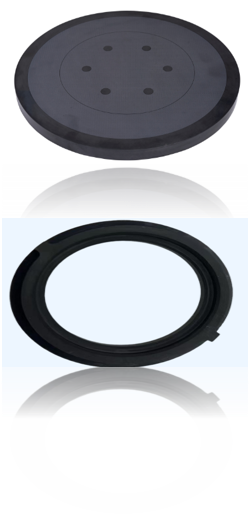
If a guide deflects under load, assess its stiffness. If its surface wears, examine contact pressure, the mating material and surface finish. Silicon carbide can address both stiffness and wear, but grinding it after sintering takes time. Specify which faces actually need finishing. For a locator prone to cracking around a hole, consider zirconia and review edge distance and fastening loads.
A worked example: how much temperature drop is in the substrate?
Suppose 10 W flows steadily through a uniform tile 1 mm thick over an effective area of 1 cm². Ignore edge losses and contact resistance. Using ΔT = QL/(kA) and illustrative conductivities of 33 and 170 W/(m·K) for alumina and aluminum nitride respectively gives about 3.0 °C across alumina and 0.59 °C across aluminum nitride. These are temperature drops between the two faces of the tile. The chip, interface layer and heat sink each contribute their own drop. Improving the substrate has limited effect on a poor mounting interface.
Distinguish wear, deflection and chipping
A guide face that slowly wears thinner calls for an examination of wear tracks, contact pressure and the mating surface. If the guide moves under load and springs back, examine span, section and elastic modulus. A chipped hole rim points to a different mechanism: a small flaw may grow under local clamping stress. Hardness describes resistance to local indentation; fracture toughness describes resistance to crack growth. A wear-resistant silicon carbide edge can still chip, and a tougher zirconia locator still benefits from careful edge geometry and support.
Turning the choice into a drawing
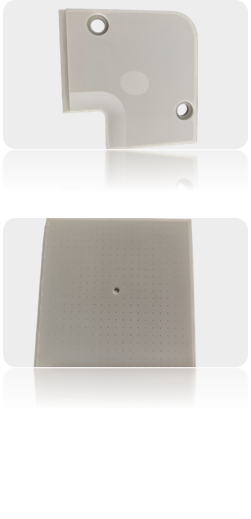
For a drilled insulating plate, identify which face touches metal, where a voltage difference exists, the direction of heat flow and which fastener bears on the thin section. Those details guide grade selection, thickness, edge distance and the faces requiring grinding. A typical dielectric-strength figure describes a material test. Finished-part withstand voltage also depends on thickness, edge geometry and surface condition and should be verified under the intended assembly conditions.
From material properties to the part
For chip cooling, an aluminum nitride substrate conducts heat toward the heat sink. Performance also depends on the contact interface and the heat sink itself. For a loaded locating part, identify the load path and the material remaining around each hole before assessing whether zirconia is suitable.
JIUFANG MATERIALS supplies custom ceramic components for equipment manufacturers. Share your drawing, operating temperature, insulation requirements and mounting arrangement to discuss material and machining options.
Further reading · KYOCERA: fracture toughness
Technical references: Thermal conductivity;Electrical insulation