

Why Use Aluminum Heaters in PECVD Equipment?
In large-area PECVD, the regions between heater tubes must also reach the process temperature. In temperature-sensitive processes, differences across a substrate can affect film thickness. Aluminum helps spread heat laterally from the tubes into these intervening regions.
How does heat reach the space between tubes?
Supplier data gives room-temperature reference thermal conductivities of about 167 W/(m·K) for 6061-T6 aluminum and 15 W/(m·K) for 304 stainless steel, a ratio of roughly 11 to 1. For comparable geometry and heat-transfer conditions, aluminum spreads heat more readily across the plate. Substrate temperature uniformity also depends on tube spacing, edge losses and contact conditions and must be checked at operating temperature. These values are for material comparison, not a statement of high-temperature conductivity or finished-heater uniformity.
| Material | Thermal conductivity at 20 °C [W/(m·K)] |
|---|---|
| 6061-T6 aluminum | 167 |
| 304 stainless steel | 15 |
Cleaning conditions and welded construction
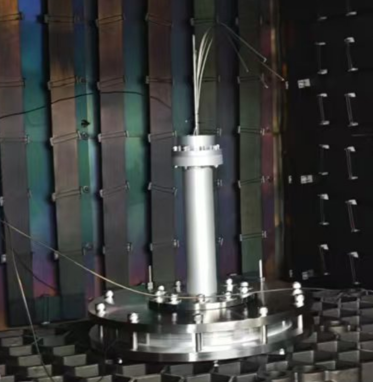
For fluorine-containing cleaning processes, assess compatibility for the specific cleaning agent, temperature, exposure time and plate surface treatment. Verify suitability under the intended cleaning conditions. Heater tubes and temperature sensors can be placed in machined grooves and sealed inside the plate by welding to isolate them from process gases. Grooving, welding and leak testing can add cost compared with a simple surface-mounted construction. Actual cost depends on dimensions, quantity and acceptance requirements.
Lower weight and allowance for thermal expansion
For the same volume, an aluminum plate weighs about one-third as much as a stainless steel plate. Aluminum also expands more when heated. For a large plate, allow for movement at the mounts and check flatness at operating temperature. Warping can change how the plate contacts the substrate.
Defining a measurable uniformity requirement
Agree on what will be measured. Plate temperature describes the heater surface, while substrate temperature also depends on heat transfer at the interface. Compare locations above the tubes, between adjacent runs and near the edge during warm-up and after stabilization. Specify operating temperature, load, stabilization time and how temperature variation will be calculated before comparing simulated and measured results.
Following the heat from tube to substrate
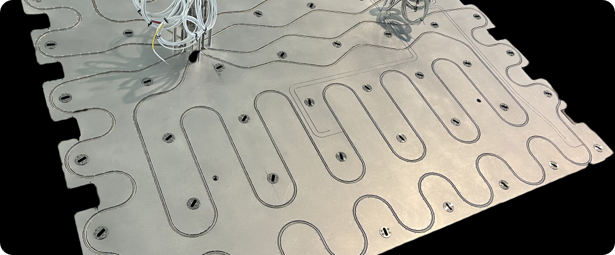
Think of the space between adjacent tube runs as a lateral heat path. Heat enters near the tubes and spreads into the region between them. In a steady one-dimensional approximation, the drop required to carry heat flux q over distance L is qL/k. A larger conductivity k gives a smaller drop for the same flux. That helps explain how aluminum smooths the temperature variation above and between tubes. At the plate edge, heat losses and the distance to a tube can change, so a center reading cannot stand in for an edge measurement.
How can one sensor reach setpoint while the plate is uneven?
For illustration only, suppose the center, inter-tube and edge readings stabilize at 200, 198 and 195 °C. The center meets a 200 °C setpoint, yet the measured range is 5 °C. An acceptance criterion should specify whether uniformity means the hottest-to-coldest range, the largest deviation from setpoint or a percentage relative to a defined reference. Record sensor location, plate or substrate measurement, load and stabilization time. Without those conditions, two reported uniformity values may describe different measurements.
Why check hot flatness and sealing separately?
Free thermal expansion is approximately ΔL = αLΔT. At the same temperature rise, a longer plate needs more movement at its mounts. Constraints or a temperature gradient through the plate can lead to warping. Warping can in turn change substrate contact and its temperature distribution. Three checks answer different questions: thermocouples measure temperatures at agreed locations, hot geometry measurements assess shape, and helium leak testing checks the welded boundary. Passing one does not establish performance in the other two.
Heater manufacturing and verification at Jiufang
JIUFANG MATERIALS designs and simulates heaters, produces heating wire and manufactures complete aluminum heater assemblies. Verification capabilities include thermocouple testing, vacuum helium leak testing and reliability testing. For a custom design, share the heated area, operating temperature, allowable substrate temperature variation and cleaning conditions so the team can review the tube layout and acceptance criteria.
Technical references: Material data;Material data